
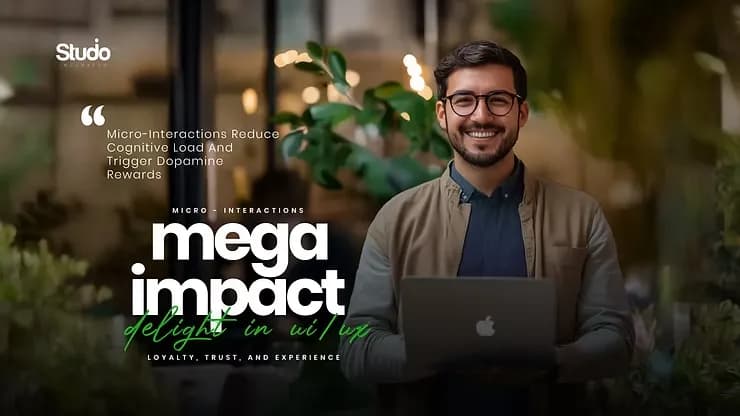
Micro-Interactions, Mega Impact: The Psychology of Delight in UI/UX

On this page
The Little Things That Make Big Impressions
Ever noticed how a red heart gently bursts when you like a post, or how a soft vibration confirms your tap went through? Those moments are micro-interactions — the quiet gestures of digital empathy.
They may last only milliseconds, but they linger in memory. Like the smile of a barista handing your coffee, these details don’t change the function — they change the feeling.
And in design, feeling is everything.
What Micro-Interactions Really Are (and Why They Matter)
Micro-interactions are the tiny responses that make digital experiences feel human — a tap, a blink, a buzz, a ripple of color. They reassure, reward, and guide.
What makes them powerful isn’t the animation itself — it’s the psychology behind it.
Humans crave acknowledgment. We want to know our action mattered. When the system reacts, we feel seen — and that moment of validation keeps us coming back.
That’s not design magic. That’s emotional design.
The Psychology of Delight
Great micro-interactions do more than look nice — they communicate trust.
- A button glow confirms “yes, I heard you.”
- A progress bar eases uncertainty.
- A playful animation sparks joy in a mundane moment.
These small cues reduce cognitive effort and trigger a tiny dopamine hit — a reward loop that transforms usability into loyalty.
Delight, when done well, is not decoration. It’s memory engineering.
Designing for Emotion, Not Just Motion
The best designers know restraint. Every micro-interaction should serve a purpose — to guide, reassure, or delight.
Here’s the secret: the most memorable designs often go unnoticed. They simply feel right.
And yet, getting them right takes a deep understanding of timing, emotion, and behavior.
That’s the part most skip — the psychology beneath the pixels.
The Future of Micro-Interactions
As AI and personalization evolve, micro-interactions are becoming adaptive. Imagine:
- Animations that respond to user mood.
- Voice feedback that sounds empathetic, not robotic.
- Haptics that “speak” through touch instead of visuals.
The next generation of designers won’t just design buttons — they’ll design moments.
Moments that make technology feel less mechanical and more human.
Learning the Art of Invisible Delight
At Studio Incubator, our Advanced UI/UX Master Class helps learners decode the psychology behind micro-interactions — the science of why people smile when a button bounces back, and how to use those details to create emotion-driven experiences.
Because the truth is simple:
✨ Micro-interactions make people stay. Emotion makes them remember.
Are you ready to design not just usable interfaces, but lovable ones?
Studio Incubator
Faculty & Administrative Staff
Official administrative and admissions desk for Studio Incubator, Shivajinagar, Pune.